

2,313,729: That’s the total number of trees stumped in Ethiopia since the project launched!
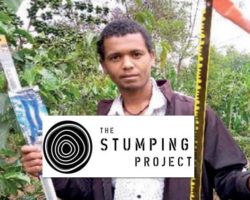
Sweet Maria’s has been contributing to The Stumping Project in EthiopiaEthiopia, formerly known as Abyssinia, or a coffee cultivar: Ethiopia, or more specifically the Empire under Haile Selassie, was known as Abyssinia. The name is Latin, derived from... ...more since its inception, and posting regular updates. The project is a training program to show farmers how to rejuvenate old coffee trees, in order to get better yields of coffee cherryOriginally coffee literature referred to the fruit of the tree as a "berry" but in time it became a cherry. It is of course neither. Nor is the... ...more, and more money for them and their families!
The latest news is a staggering 2.3 Million trees that have been stumped, which permits regrowth of old plant tissues and rejuvenated coffee production.
Ultimately, it is YOU, our customers, who allow Sweet Maria’s to contribute to this important investment in the future of Ethiopian coffee farmers, and the improvement in their livelihoods. So thank you!!
The project has already exceeded their original farmer training goal. While the program aimed for 77,750 participants, Regrow Yirga has trained 95,642 farmers to date—including 42,935 women (45% of all participants)—across all eight woredas in Gedeo Zone. This strong female involvement underscores our focus on coffee as a family enterprise, with shared decisions and benefits at the household level.
Stumping has emerged as the project’s most transformative practice. At baseline, only 4% of households stumped trees; by 2022–2024, adoption soared to 60%.
Nearly a third of adopters stumped across multiple years, rejuvenating an average of 106 trees per household. The 2022 training cohort alone saw 12,511 households revitalize 1.326 million trees over three seasons.


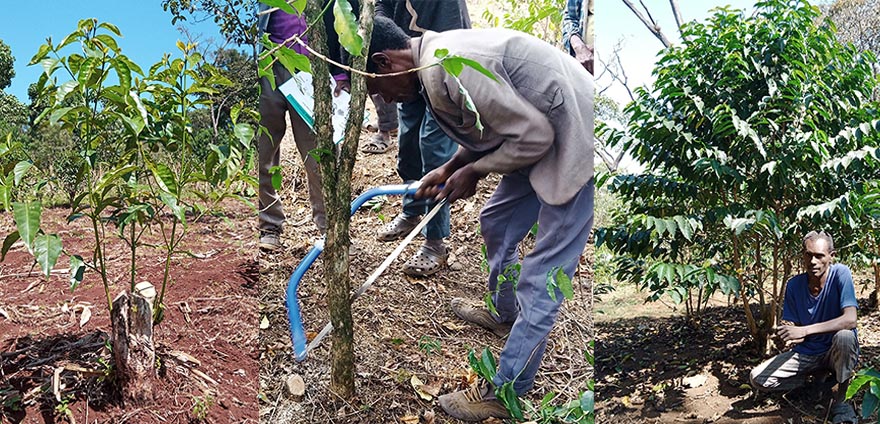
From the 2023–2025 cohorts, monitoring reveals an additional 2.3 million trees stumped. Each cohort showed higher adoption and more intensive stumping with incentives.
A tree count verification confirmed 9,303 households stumped 779,488 trees—an average of 84 trees per household.
This reflects how stumping has become a widely normalised practice in Gedeo Zone, supported by strong peer-to-peer encouragement, visible results on farms, and active government engagement.
Overall, 16,373 households across the 2022, 2023, and 2024 cohorts have qualified for incentives.
Early results for the 2025 cohort are especially strong. Within the first three months of training, 7,297 households, 83% of all registered, reported stumping 485,018 trees, the highest first-year adoption rate seen so far. These farmers will receive incentives once the tree count is verified for stumping in 2026. Stumping is expected to continue increasing as more farmers observe the clear benefits on their neighbors’ farms.
In addition, yield surveys provide strong evidence of the impact of stumping and other regenerative practices. Comparing stumped and unstumped trees on the same farms, the project recorded that stumped trees produced 1.6 times more cherryEither a flavor in the coffee, or referring to the fruit of the coffee tree, which somewhat resembles a red cherry.: Either a flavor in the coffee, or... ...more in the 2023/24 season, and 2.7 times more in 2024/25, for trees stumped in 2022. Based on tree counts from the 2022 cohort, yields reached 361 kilograms of green coffeeGreen coffee refers to the processed seed of the coffee tree fruit. Coffee is a flowering shrub that produces fruit. The seeds of the fruit are processed, roasted,... ...more per hectare in 2024/25, already above the project target of 322 kilograms.
Recruitment is underway for the final 2026 cohort of 12,000 farmers, which will position Regrow Yirga to exceed its goal of reaching 100,000 farmers by 2028.
Solomon Biwata and Mulunesh Wanisara
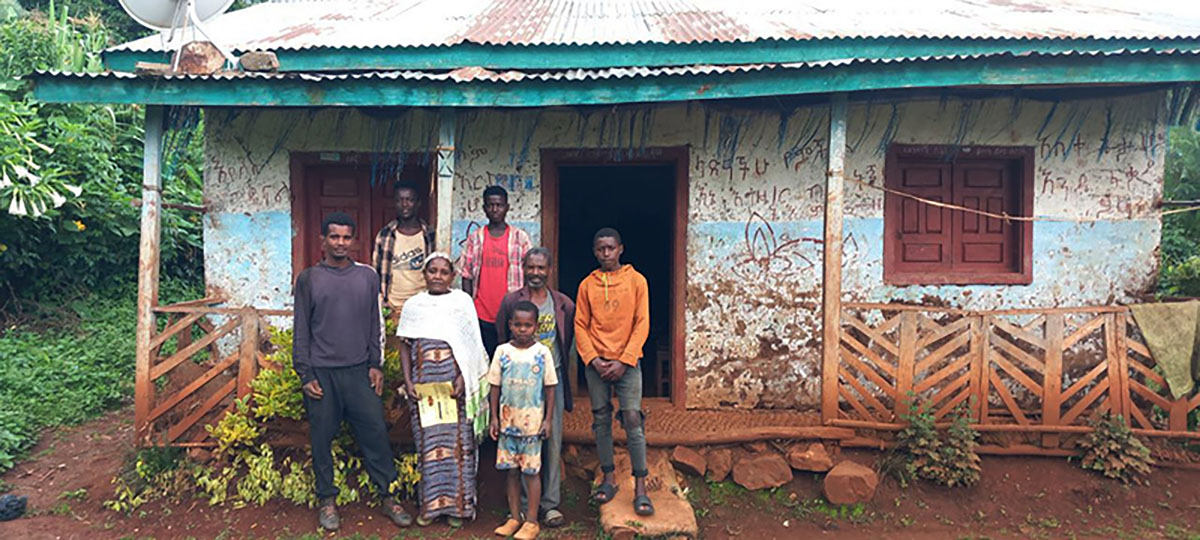
The experience of farmers like Solomon Biwata and his wife Mulunesh Wanisara illustrates the real change the program is bringing to households.
Living in the Shigedo kebele, the couple managed a one-hectare coffee farm with nearly 2,000 trees, but like many smallholders, they watched their yields decline to less than one kilogram of cherry per tree.
With nine children to support, each harvest brought more uncertainty. After joining Coffee Farm College in 2022 and learning about stumping through hands-on training and demonstration plots, they decided to stump 500 old trees that year and another 500 the next. They knew this would temporarily reduce their harvest, so they intercropped haricot beans to support the family and help enrich the soil.
By 2024, the first round of stumped trees produced three kilograms of cherry per tree, up from just 0.6 kilograms in 2021.
Their annual income from coffee increased by 186 percent, and the couple received a wheelbarrow incentive that made transporting compost, mulch, and harvested cherry far easier.
With their improved earnings, Solomon and Mulunesh have been able to upgrade their home, support their children’s education, and reinvest in new income streams such as sheep fattening, with plans to expand into cattle and dairy production. Their success has encouraged neighbouring farmers to adopt stumping as well.
Across Yirgacheffe, stories like Solomon and Mulunesh’s show how regenerative agriculture and targeted incentives are helping farming families build stronger livelihoods while improving the long-term productivity and sustainability of Ethiopian coffee.
Yeshi Elema
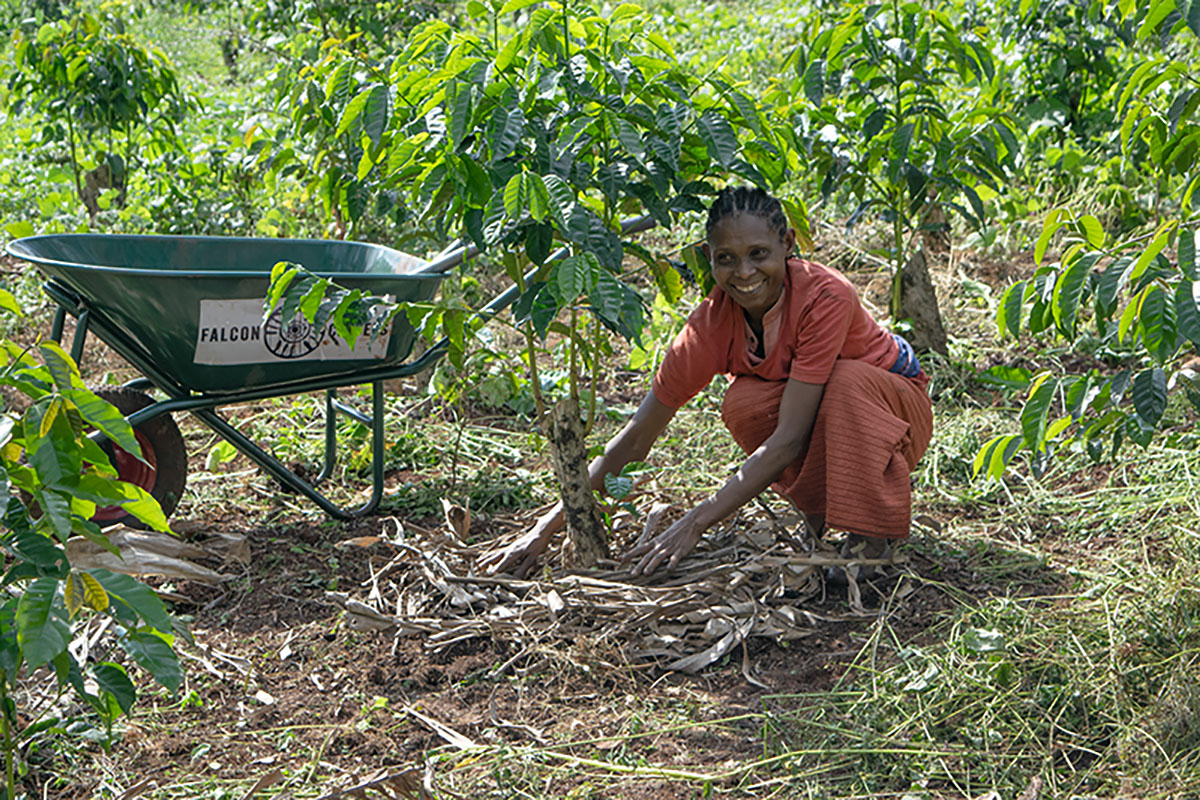
Yeshi Elema is a 35-year-old widow living in Hanchebe Kebele, Kochere Woreda, in the Gedeo Zone. She supports her five children: three sons aged 6, 10, and 12, and two daughters aged 15 and 16. Yeshi manages a coffee farm with approximately 800 coffee trees on a 0.5ha plot. Initially, she faced enormous challenges as a farmer, struggling with zero yields from her old coffee trees. She recalls, “I was constantly worried about how to provide for my children’s education and future.”
In 2024, Yeshi connected with TechnoServe, a partnership that proved to be a turning point in her life. Through the programme, she learned valuable regenerative agriculture techniques, including composting, intercropping, and stumping, which revitalised her coffee farm. “The training opened my eyes to new methods. I never knew how much difference it could make,” she shares.
This year, she has stumped 103 coffee trees as part of a new incentive programme, qualifying her to receive a high-quality wheelbarrow sponsored by Falcon Coffee. The wheelbarrow has been particularly beneficial for Yeshi: “With the wheelbarrow, I can move compost and supplies without exhausting myself. It has made my daily tasks so much easier, and I no longer need to ask my children to help me carry heavy loads,” she explains.
Yeshi dreams of drying her coffee and selling it for a better price, knowing that dried coffee commands a higher market value compared with selling it as cherries. She says, “I believe that drying my coffee will help me earn more and provide better for my family.” The Coffee Farm College training encourages farmers to keep farm records that will enable Yeshi to make objective farm management decisions such as this.
Despite her initial concerns about low yields and inadequate income, Yeshi’s farm is now on the verge of transformation. While she has not yet seen profits from her stumped trees, she has diversified her crops through intercropping, producing enough beans to sustain her family, and her coffee trees have been rejuvenated. “This not only feeds my family but also ensures sales in the future,” she adds.
Yeshi’s dedication and hard work have not gone unnoticed. Within her community, she has gained respect and recognition for taking control of her farm and working to improve her family’s circumstances. “I feel proud to show others that women can own and run businesses,” she says.
Looking ahead, Yeshi is filled with hope for her family’s future.
She wants to establish a small livestock business and create opportunities for her children that she never had. “My dream is for my children to have a better education and life than I did.” In Yeshi’s words, “Coffee for me is the backbone of my life and main source of income.” With the knowledge she has gained from this project, she is on a path not just to sustain her family but to make a better life for her children.
Across Yirgacheffe, stories like Solomon and Mulunesh’s and Yeshi’s show how regenerative agriculture and targeted incentives are helping farming families build stronger livelihoods while improving the long-term productivity and sustainability of Ethiopian coffee.
2 Responses
This is a great story. We need more of these success tales.
thank you for telling these wonderful stories. at 77 i have no memory of not drinking coffee! i traveiled the world. 8+ million miles on AA. i tasted coffee where coffee trees are grown. tea drinking wife of 35+ years never touched the stuff.