

Poppo can roast 110 grams quickly, evenly … even to darker roast levels. Here’s some tips to get the most out of it!
Here’s Poppo air popcorn popper FAQ for coffee roastingThe application of heat to green coffee seeds (beans) to create palatable material for brewing a great cup!: Coffee roasting is a chemical process induced by heat, by... ...more, going over the little tweaks we use when roasting with the Poppo kit. But let’s start with a short 4 minute video which, quickly runs through the main points:
The Poppo Air Popcorn Popper kit for coffee roasting is just $28.50, or $39.50 with a starter green coffeeGreen coffee refers to the processed seed of the coffee tree fruit. Coffee is a flowering shrub that produces fruit. The seeds of the fruit are processed, roasted,... ...more sampler set of 4 coffees!
Poppo Air Popcorn Popper FAQ
-
The Poppo sleeve moves around while roasting coffee. Can I change that?
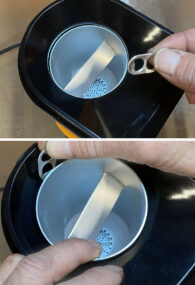
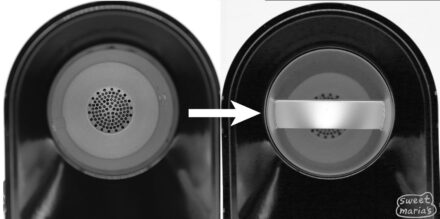
When you place the sleeve in the Poppo chamber, it’s not too important which way it faces. In some units, the sleeve fit is tight, and in others it can be a little loose. (The popper is a low-cost machine, and the spec on the roast chamber can vary slightly.)
The thing I don’t like about a sleeve that is loose, is when you pour the coffee out at the end of the batch, the sleeve tends to go with it …and the sleeve is dang hot.
If you prefer the sleeve not to move around, wedge a bit of tin foil, or better yet, a soda can tab between the chamber and the sleeve. It works! -
How many roasts can I do in a row in Poppo
It’s entirely possible to do multiple roasts in Poppo in one sitting. BUT it is important to let the popper cool down 15 minutes between roasts. There are 2 reasons for this.
1 . Roasting back-to-back without a cooldown period will shorten the life of the machine.
2 . Starting a new roast in a hot Poppo popper means it will roast faster, and inconsistently. To get similar roast results, you want to start each roast with the metals roast chamber and internal elements fully cooled. -
Poppo is roasting fast. Can I slow it down?
Air roasting transfers heat quickly to coffee. By nature it’s a faster roast process than other types.
– Two factors make Poppo roast faster: A high AC power level and your ambient room (or outdoor) temperature.
– Higher voltage means Poppo operates at higher wattage and roasts faster. (Often when you use an outlet closer to your fuse panel, the voltage is higher).
– Higher ambient temperatureThe temperature in a given room or space: This term is used to describe the overall temperature in a given environment, and is an important variable in coffee... ...more means the air Poppo takes in through the base heats easier. These things speed up the roast! -
How does a faster roast impact coffee flavors?
On many occasions, we have compared the same coffee roasted at different speeds in different machines. I have checked a varietyA botanical variety is a rank in the taxonomic hierarchy below the rank of species and subspecies and above the rank of form (form / variety / subspecies... ...more of Poppo roasts ranging from 3 minutes to 5 minutes (and even some roasts I slowed down that were 9 minutes). With the faster roasts, I feel there is a distinctly “tangy” roast tasteThe set of flavors that result from the degree-of-roast.: Roast Taste is a term we started to distinguish it from "Origin Flavor". We use the "roast taste" term... ...more that is more striking, paired with a higher level of brightnessA euphemistic term we use often to describe acidity in coffee. A bright coffee has more high, acidic notes. : A euphemistic term to describe acidity in coffee.... ...more in the cup. Longer drum roasts might be more”balanced” but don’t have the zingy aspect of this particular roast flavor and dynamic brightness. This works well with brewed coffeeBrewed Coffee refers to all coffee preparations produced by adding non-pressurized water to coffee grounds. Contrasted with espresso coffee, which is produced under pressure, brewed coffee is primarily... ...more. But I do think air roasts like this are not ideal for espressoA small coffee beverage, about 20 ml, prepared on an espresso machine where pressurized hot water extracted through compressed coffee.: In its most stripped-down, basic form, this is... ...more. It’s important to note that you don’t want to slow down air roasts to match those of other machines, like drum roasters. Each type of roaster has a different heat transfer dynamic, and there is not a single ideal roast time or heat profile that is true for all roasters. Out focus is to get the best roast taste from each type of machine, given it’s particular thermal variables. Yep, even for the humble air popcorn popper too!
-
How can I roast at lower wattage to get a longer roast?

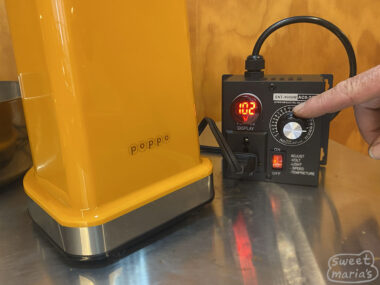
AC voltage levels can vary from outlet to outlet, and also during the time of day. More importantly, the drop in voltage when you start the roast can impact the popper heat level. Using a low cost Wattmeter can be informative about the line voltage, voltage drop, and wattage the popper is using. Outlets farther away from your electric fuse panel tend to have lower voltage.
You can also use a Voltage Controller, a relatively low cost device that lets you “turn down” the voltage. (Tip: I found Poppo runs great at around using 1200 watts at 60 f ambient temperature. at 1300 I find it is a bit fast in roasting). -
How ELSE can I lower the wattage to get a longer roast?

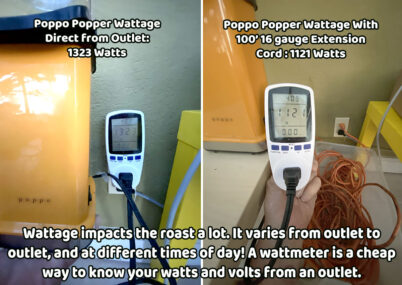
If you look online for tips on roasting coffee in an air popcorn popper, you will see the same DIY trick to slow down the roast: Use a 100′ extension cord!
While it’s not as slick as using a voltage controller, I’m here to say yes, it truly works.
If you enlarge the image here, you can see that the watt measurement straight from this outlet versus using a 100′ 16 gauge extension cord is nearly 200 watts higher.
(Correction from image: It is best NOT to have the extension cord in a reel or bunched up as in the image. It is best spread out, as I am told a spooled extension cord can form an induction coil and actually increase voltage, doing the opposite of what you want).
Also be aware that outlets closer to your homes electric panel tend to have higher voltage, and that the voltage can vary during the day. All these things impact the consistent results from an air popper, or really any coffee roasterA machine for roasting coffee. Or the person operating it! The basic requirements for a coffee roaster are a heating element that gets suitably hot and a mechanism... ...more! -
How does ambient temperature change the roast?
When using an air popcorn machine, you are drawing in the ambient air from the bottom of the popper. If it’s warm out, this tends to speed up the roast … and if it’s cold it really slows it down a lot! We hear of many people who are “asked to leave” the kitchen / indoors when it’s time to roast coffee by their family members. So they end up on a back porch or garage.
In the winter this can really stall the roast. You can use this to your advantage though, to roast in a place with cooler air to slow your roast, or find somewhere warmer to speed out up.
(To check the impact of ambient temperatures, I roasted 110 grams of coffee outdoors in 50 degrees ambient temperature and had a 7 minute roast. The following day, in the midday sun and 65 degrees I had a 4 minute roast to the same roast level!) -
What hot air poppers does the Poppo coffee sleeve work with?

We designed the Poppo coffee sleeve to work with the Poppo popper.
In theory it could work with other air poppers but they would have to be the same design, and have the same size popping heat chamber. Poppo is also tapered, wider at the top and narrower at the bottom.
Poppo sleeve does not work with any air popcorn machine that swirls coffee in a circular pattern. The sleeve doesn’t work with the popper type historically recommended (by us too!) for adapting as a coffee roaster.
It does not work with the Nostalgia popper that we have carried, or West Bend models that swirl the coffee in a circular pattern. -
The clear hood on the Poppo is discoloring and warping. What can I do?
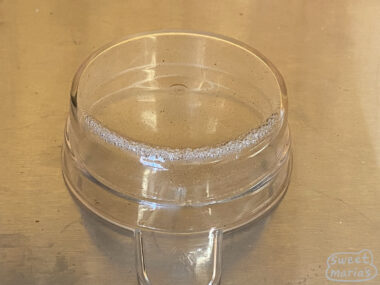
Washing the hood and dish between roasts in hot water and soap (no scratchy pads!) Can really help with visibility.
As for warping, it’s true that the hood will warp over time, as it does with all popcorn poppers used for roasting coffee. Poppo is, sadly, no different. It’s a low cost popcorn popper, and the hood is being exposed to sustained heat beyond what it would when making popcorn.
This is an expected result of using a popcorn popper for roasting coffee, including Poppo or any other popcorn machine.
Sweet Maria’s will stock a low cost replacement top soon, but most people start roasting outside without a top, or make a DIY substitute such as a glass chimney hood. -
Why should I catch the chaff coming from the machine?

ChaffChaff is paper-like skin that comes off the coffee in the roasting process. Chaff from roasting is part of the innermost skin (the silverskin) of the coffee fruit... ...more is a bit messy, and maybe the main reason people use air poppers somewhere other than their kitchen. In our video we show how you can even adapt the Poppo box to catch the chaff.
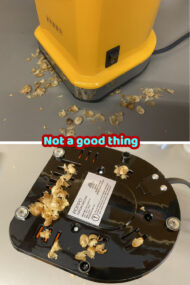
Besides being messy, the reason is that chaff that falls around the base of your popper gets will block the air intake, which is on the bottom of the machine.
This is true for most air roasters: the chaff can harm the machine and shorten it’s lifespan. So no matter how you control the chaff, don’t let it pile up around the popper base.
As with all coffee roasters, this is a reason to stay by the machine during operation and monitor the roasting constantly.
In particular, popcorn machine roasting is very fast, and 10 seconds difference at the end of the roast has a big impact on coffee flavorThe overall impression in the mouth, including the origin character as well as tastes that come from the roast.: This is the overall impression in the mouth, including... ...more! -
How to I add time, temperature and heat control to the Poppo Kit?

You can with a lot of DIY hacks or you might consider the Popper Coffee Roaster for just a few dollars more (or probably less with the cost of the gadgets you need to hack the Poppo!) Popper is $79 and adds a lot of features to control the roast and make it easier.
46 Responses
So, pretty much I’m going by color with my Poppo. Is that right?
Color is important for sure. I think smell and sound are pretty important with any air roaster… well any roaster at all.
Color and sound, BUT you need to react fast once you get what you want I am finding- have gotten used to more control with the popper but needed higher heat so trying Poppo which is hotter than my earlier West Bends and Heritages (well one of those was a bit of a torch…). If you are expecting a nice gap before second crack and have non/winter air temps, you may be surprised at how quick the transition is.
I am suprised how much ambient temperature matters. At 65 f daytime I did a roast that had little gap between first and second crack. That evening, 52 f outside and very long clearly defined gap between end of first crack and initial snap of second. Also my voltage and therefore popper wattage tends to be lower in evenings.
Wow, does this thing roast fast. The good news is that the roast is more even, beans puff up much more, and the cracking is much more audible, compared to the Nostalgia (which took forever in the winter here in Boston). The bad news is that it’s very hard to time the drop. One second the beans are quite light, the next they’re dark and starting to smoke. I’ll have to get better with the voltage regulator, lowering the voltage earlier.
The other disadvantage compared to the Nostalgia is that it doesn’t have a lip to hold onto, and you really have to use the hood (or else beans tend to fly out).
I’ll repost some experiences when I’ve done a few more batches and have the technique down better.
Yes … slowing down this beast is the focus, vs the nostalgia that is easy to overload, and tends to stall in colder weather. As you can see the page here tries to address reasons the roast can go extra fast, and some ways to slow it down.
Easier said than done. I’ll just have to practice preparing for the drop when the bean are lighter.
Lagging behind Lee, but similar experience re. Heat control and timing. Need to add some darker roasts and the Poppo with replaced fan is not that tool. My education continues
I am wondering if you guys have any tips for light roasting of green beans with Poppo.
Instead of ambient temperature monitoring to set a timer, relying on crack sound such as “wait for xx seconds after hearing a first few sounds of a group of first crack sounds and then pour roasted coffee into a cold metal container to cut down coffee roasting immediately”
Its a very good question, but hard to give an exact answer in terms of time. Poppo is generally a fast roast process, but it depends on voltage and room or ambient temperature. When I roast at home (where the machine measures 1100 watts on the wattmeter, and roast takes about 6 minutes to City+ roast) I am generally stopping the roast about 1:30 after I hear the first pop of first crack. This is a rough estimate though. When I roast indoors at work, the machine measures 1350 watts, and roast is 4:30 minutes to C+ level. There it is 45 seconds from start of first crack until I stop it. One thing I will say (and wanted to make a video about this too) is for light roasts, I generally and stopping the roast a bit before 1st crack would normally end … until it goes quiet and before 2nd crack starts. Its still audibly popping when I stop it, although it has passed the point where it is super rapid. Thats how I get a good light roast in an air popper. If I waited until it was fully through 1st crack and was quiet, it would already taste fairly dark…
Hey Tom, does elevation affect the roast time? I live at almost 5000 feet and find that my roasts better not go much beyond 4-ish minutes, or I’ve got a bunch of burnt beans on my hands. I roast outside on a protected patio, connect the Popper to a 20 ft extension cord, and my ambient temperature is usually high 50s to low 60s. Is there a general time range to follow when roasting with the Popper at high elevation?
It does, but I have to admit this is not some thing I have a lot of experience with, since I’ve never lived at high altitude while roasting coffee. The erratically, if water boils at a higher temperature, then first crack seems like it would happen later, if I have my head on straight. So if first crack starts at 400 Fahrenheit at sea level maybe it is 405 at 5000 feet, something like this? But as I say, I am without first experience on this.
Regarding roasting at higher elevations, water boils at a lower temperature at lower pressures. My guess would be that 1st crack would happen sooner. What effect this would have, I don’t know, but it seems you would have a somewhat earlier warning – which in this roaster is probably a good thing.
Yes for sure. Since first crack is basically the point within the bean where water turns to water vapor, elevation definitely has an impact.
Will the glass chimney affect performance of poppo?
Honestly I need to spend some time testing this more. I will do that …
One issue: depending on the diameter of the chimney, some tend to sit will inside the roasting chamber – if so they might not sit well because they might be bumping up against the defelector bar in the popper sleeve . I’ll try a few different chimney glass I have and see…
Any updates on the use of glass chimneys or other extension tubes ?
Haven’t really seen the benefit of an extension tube. The only possibility is to slightly increase the batch – at 120 grams coffee can start ejecting from the Poppo. A slightly higher collar would hold it in. But it doesn’t change the performance, and increases batch by perhaps 20 grams
My poppo quit working after 2 roasts. Can I return it for a new one?
Yes for sure. You are not the only person this has happened to, but it is rare and we are trying to find out more about it. (We can’t reproduce the issue unfortunately). If you email [email protected] we can replace it, but also maybe you can help us share some insight into the circumstances. We think there may be some voltage conditions that the Poppo just cant handle, but we aren’t sure.
What metal is the poppo sleeve made from?
Aluminum.
Can Poppo handle 220v?
no sorry – all our roasters are 110v only
Would rubber banding a grocery bag to catch the chaff affect performance?
That’s a new idea. It would work well but if it impedes the flow of hot air then it could make the roast go faster ( which it’s already very fast. ) we have used a cardboard box with a cut out for spout to good effect.
Does it make any difference whether I have the small tray on top or not during roasting?
It does change the air flow I believe … but when I use the Poppo outside I don’t even have the top on at all. I think their air flow is so strong the impact isn’t big with the tray / dish on or not. Without it, its easier to see the coffee
I just bought the poppo roaster and have not used it yet. Does it produce a lot of smoke and should it be used outdoors?
All roasters do have smoke, as well as some chaff that comes off the coffee too. It might be best to try it on a deck or balcony. I put a cutting board on my stove top (for a level surface) and use it under my stove vent hood. Then a use a small box to catch chaff. The box it comes in is good for this!
My third Poppo (or equivalent from Amazon) just burned out. I always do 2 roasts back to back. I do use a voltage regulator to slow down the roast as it proceeds.
My question is – is there some other way to mitigate this? I don’t want to make each roast a long affair by waiting between batches. Maybe the aluminum sleeve should have holes in it, so it allows the unit to cycle a bit. The old style popcorn maker lasted much longer (but took longer for each batch), presumably because it was cycling when it overheated.
Is the Popper more resistant to this, because the heating element can be controlled independently from the fan?
Hello Lee, our only real recommendation to extend the lifespan of any machine using “air popper technology” is to let it fully cool between roasts. If you choose to roast back to back, they will ultimately wear out much faster. This is true for Poppo, Popper, Fresh Roast, etc. We recommend 15 minutes between batches at a minimum, but the more you let them cool down the longer they seem to last, in our experience. Otherwise (as you note) they tend to burn out! All the basic popcorn popper type units have a safety thermal cutoff switch which will cause the heating element to deactivate if the chamber wall temperature is above a certain threshold, but we wouldn’t really call it a “cycling” feature for heat management or cooling. It’s more of a last resort for safety. For more roasted coffee in less time, most people find themselves considering a machine with higher capacity like a SR800 or Behmor AB2000, but those obviously come at an increased cost.
I just roasted my first batch of beans in the Poppo and it took 4 minutes to a medium roast in a 65 degree room. I haven’t tasted them yet, but I don’t love the way they smell. Rather than dealing with lower wattage and a slower fan I’m wondering if roasting in stages is an option? That is, roast 1-2minutes, dump the beans out and let everything cool down and then do another 1-2 minutes? And so on until crack, and desired color?
Hello Carroll, what you’re describing goes by a couple names but it seems the most common is “double roasting.” If you search “double roasting coffee” there’s some interesting reads on other coffee forums and blogs from people who have tried it for one reason or another. It’s not something we’ve exactly experimented with here, but we’ve definitely had a roaster accidentally enter a cooling cycle before we were ready and powered it back up to finish a roast. Usually (but not always) the coffee tastes okay when this happens. It’s not exactly what you’re describing but similar idea.
Like all things coffee roasting, whether double roasting produces good results from you ultimately comes down to personal taste. Some (I would say the majority) don’t seem to get results they like. The flavor is often described as “flat” or “grassy.” But some people also report really liking it! The good thing about Poppo is that the small-ish batch size means it only costs 100ish grams of coffee to try something out to see how it goes and if it doesn’t work the loss is small.
A couple of notes about double roasting: 1) it’s usually used by people experimenting with darker roasts, so if you’re trying to get a lighter roast this probably isn’t the best path forward. 2) The second roast will probably go very fast since the water content is already low and the bean will have an easier time taking up heat. Especially with something like Poppo that has a lot of power already, you’ll have to watch carefully as it will be easy to go from medium to dark to burnt very quickly.
Let us know how it goes if you give it a try. Happy roasting,
Jarrett
Tried a 100 g batch of aged Sumatra with hood on, watt meter, 50 feet extension cord and saw varying wattage (1175-1325, mostly sub 1275) during a verrry fast roast. first crack started between 1 and 2 minutes, was scrambling enough to deal with the speed I missed the exact time. Considered that beans were not moving very well in Poppo chamber, probly overloaded. Dropped second batch to 70 g, too small, but a little more time to First crack. Relearning how to work without temp and fan adjustments as I go – have moved up from paint stripper and West Bend thru rocket hot and coolerHeritages, to Popper and now Fresh Roast… but decided that popper was a good tool for the aged and some other dark roasting adventures. More to learn…
First crack between 1-2 minutes is quite fast. One thing I learned with the aged Sumatra is that there are a lot of early snaps before the “main event”. Not sure if that’s what’s happening here. But it caused me to end my batch too early initially. I did get a defined end to first C in the few batches I ran on Poppo. Not sure how dark you’re shooting for, but I think taking the roast to at least that point is good for this coffee (I prefer just the start of 2nd C). Linking the post we made about roasting aged Sumatra on Poppo here in case you haven’t seen it.
Good intuition on dropping batch size to slow things down. It seems counterintuitive for most roasters, but the smaller bean batch doesn’t do a great job trapping hot air and really does extend development time.
Hope you’re getting enjoyable roasts.
-Dan
I use a Poppo also but added a voltage/watt controller a few months ago. This reduced my roast times from 3-4 minutes to 8-10 minutes depending on outside temperature. I use with a 25 foot extension cord also just for convenience. My question is, and just looking for confirmation, is it best to start out low and slowly build up temp? I can provide more details if needed.
3-4 minutes is definitely fast, and it’s difficult for the bean to be roasted evenly from inside to outside evenly in a shorter amount of time. But the faster roast can also make an interesting cup for pour over brewing, that has tangy roast taste, and a lot of brightness. If you want to tone that down, extending the roast time works well. It allows the interior of the bean to develop roast more similar to the outside. With Popo I also use the voltage controller. But I shoot for about seven minute roast time, with first crack starting about five minutes. If you want espresso, I think you get the best roast flavor tone with nine or 10 minutes on the Popo. So I wouldn’t say one approach to the roast time is good or bad, they’re just different. But yes, I think you’re on the right track there!
I am totally new to this. If I plug poppo into regular outlet, about how long should it take for medium roast??
Thanks!
Four to five minutes. It’s a very fast roaster.
I added a voltage controller to my Poppo which doubled my roasting time from 3-4 minutes to about 8 minutes for a city + roast. I’ve started measuring the temp of the beans when I dump using an infrared temp gun. Is there a chart that show temperature vs roast level? Thanks!
Hey Mark, voltage controller’s are really effective tools for slowing the roast. Of course, there is a tipping point at which the airflow no longer moves the coffee when lowering voltage (as I’m sure you know!).
We haven’t charted heat gun temps ourselves, but that’s an interesting idea. Though I’m not sure how well temps translate to others since there’s some inconsistency in how the sensor comes in contact with on a moving mass. But it would be fun to try see how benchmark readings like yellowing and 1st C track across a few roasts.
Thanks,
Dan
I electrically separated the heating element from the blower fan on the Poppo I purchased from you. This allows me to quickly cool the element at the end of each roast. I can dump the coffee beans and let them cool at room temperature or cool them in the popper while the element cools quickly. I used a simple and cheap 120 to 24 VAC 50 VA step down transformer which cost about $20 online. The wiring procedure is simple and effective.
That’s great! Some people get a separate power supply for the fan but a step down transformer is a great way to go.
So, I’ve used a voltage controller to bring the voltage down from about 1300watts to 1000~ watts and get about the same roast time. I do 110grams and live at 5000ft. Elevation and continuously get 2nd crack and finish roast at 3-4~ minutes.
Should I be concerned about the green coffee not moving or burning in the chamber if I lower the wattage more? Do I need to decrease my batch size? I have the sleeve and I don’t get enough air to have the coffee blow over it in a cycling motion like seen in the video.
The roasted coffee tastes awful.
Hey Andrew, I would try less coffee first. It seems counterintuitive, but a smaller bean mass allows more air by the beans, slowing roast development. I’d reduce by 20 grams roasting sans voltage controller and see where that gets you. Lower voltage can be used to a point, but you have to keep the beans moving.
If you can describe what it is about the flavor that doesn’t taste right, we might be able to help dial things in.
Thanks,
Dan